

Daily Nanny Activities for Child Development: An Age-by-Age Guide
Nanny activities for child development work best when they combine responsive conversation, shared reading, movement, creative play, simple problem-solving, everyday self-care, and adequate rest. What a nanny should do each day depends on the child’s age, abilities, interests, energy, and family routine.
A nanny’s role goes beyond supervision, but that does not mean turning the entire day into formal lessons. Everyday moments talking during breakfast, naming objects on a walk, waiting for a child to respond, or inviting a toddler to put away a toy can become meaningful learning opportunities.
| QUICK ANSWER A nanny can support child development through responsive conversation, shared reading, active play, creative and sensory activities, simple problem-solving, predictable routines, and sufficient rest. The aim is consistent, meaningful interaction not keeping a child busy every minute. |
Key Takeaways
- Responsive, back-and-forth interaction is more valuable than a long list of adult-led tasks.
- Activities should match the child’s developmental stage, abilities, interests, and family instructions.
- A balanced day includes movement, language, creative play, routines, free play, transitions, meals, and rest.
- Safety rules are part of activity planning, especially for infants, water play, food, and sensory materials.
- A nanny may observe and report changes, but should not diagnose a developmental condition.

Why Nanny Activities for Child Development Matter
Early childhood is a period of rapid development. Children learn through relationships, repetition, movement, play, language, and exploration. The World Health Organization’s Nurturing Care Framework brings together five connected needs: good health, adequate nutrition, safety and security, responsive caregiving, and opportunities for early learning.
For a nanny, this means development is supported across the whole day not only during a scheduled “learning activity.” Preparing a snack can build language and self-help skills. A walk can encourage observation and movement. Tidying can introduce sorting, sequencing, and responsibility.
Responsive Interaction Comes First
Young children often “serve” an invitation to interact through eye contact, gestures, sounds, questions, or actions. A caregiver can “return” that serve by noticing, responding, naming what the child is interested in, and allowing time for the child to reply. Harvard’s Center on the Developing Child describes these back-and-forth exchanges as an important part of the child’s social environment and early development.
This approach is simple: follow the child’s attention, respond warmly, add language, and take turns. It can happen while reading, building blocks, feeding a baby, or looking out of the window.
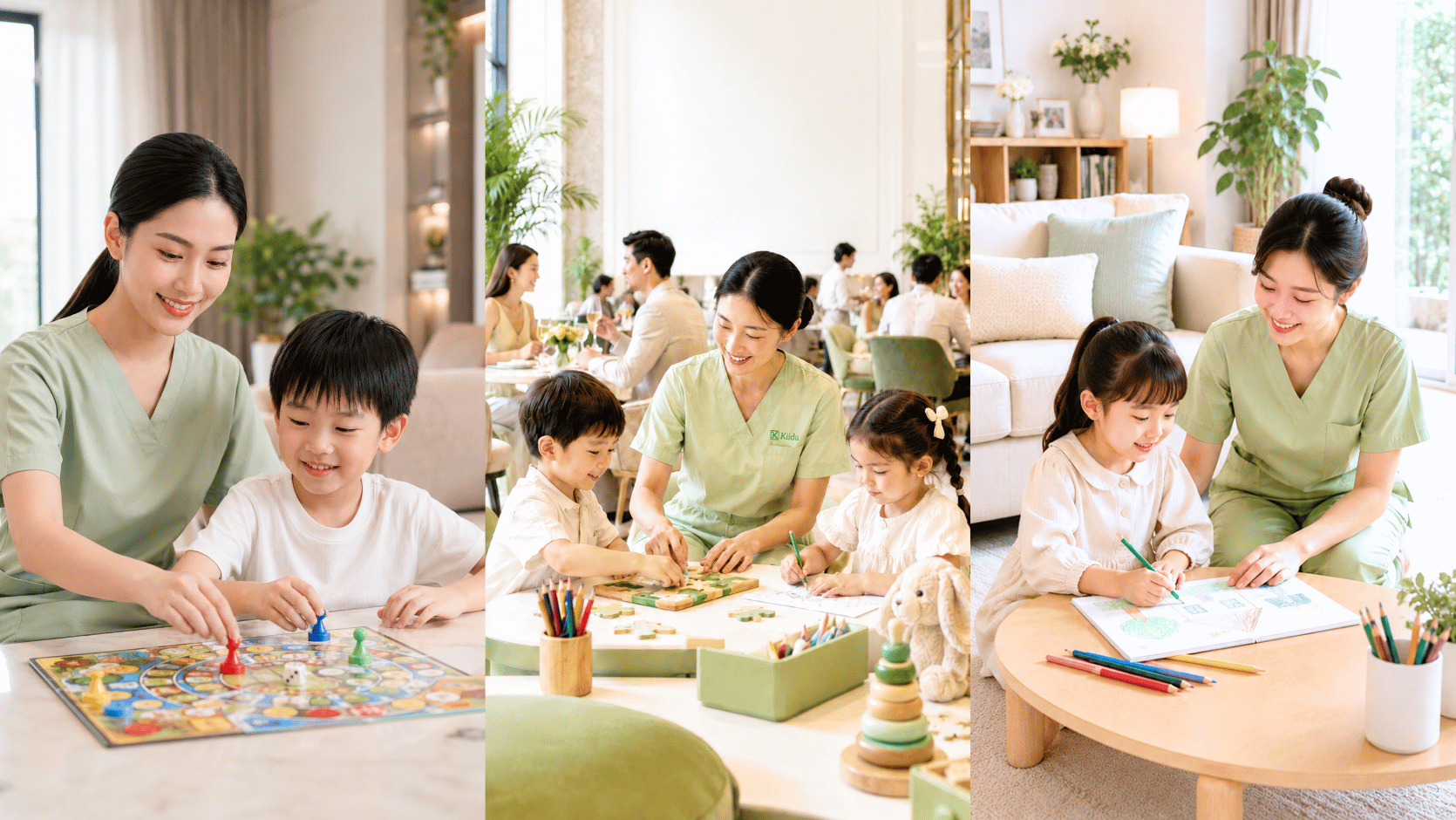
Daily Nanny Activities for Child Development
The best nanny activities for child development are not necessarily expensive or complicated. They are safe, repeatable, interactive, and suitable for the individual child.
1. Shared Reading and Storytelling
Shared reading can support vocabulary, attention, imagination, and emotional connection. A nanny can point to pictures, name familiar objects, pause for the child to respond, and ask simple questions that match the child’s language level. For younger babies, looking at pictures and hearing a warm voice is already a valuable interaction.
2. Everyday Conversation and “Serve and Return”
Language develops through frequent, meaningful interaction. A nanny can describe what is happening during meals, dressing, bathing, travel, and play. Instead of asking a rapid series of test-like questions, the caregiver can comment, wait, listen, and build on the child’s response.
3. Active and Outdoor Play
Movement supports coordination, strength, body awareness, and confidence. Depending on age and safety conditions, activities may include supervised floor play, walking, running, dancing, climbing at an appropriate playground, ball games, or a simple indoor movement course. Outdoor plans should be adjusted for heat, rain, air quality, and the family’s instructions.
4. Creative Play
Drawing, painting, collage, modelling materials, pretend play, and simple crafts can support fine motor control, imagination, and self-expression. The process matters more than producing perfect artwork. A nanny can offer a small number of choices and allow the child to explore without taking over the activity.
5. Sensory Exploration
Children can explore texture, sound, temperature, weight, and cause and effect through carefully selected materials. Examples include water pouring, scooping large objects, playing with safe dough, or exploring fabrics. Sensory activities require close supervision, age-appropriate materials, and checks for choking risks and allergies.
6. Music, Rhythm, and Movement
Singing, clapping, action songs, and simple instruments combine language, memory, rhythm, coordination, and shared enjoyment. The nanny can repeat favourite songs and invite the child to choose movements or fill in familiar words.
7. Simple Problem-Solving
Puzzles, shape sorting, matching, block building, object-hiding games, and everyday challenges can encourage attention and flexible thinking. The nanny should offer enough help to keep the child safe and engaged, while leaving room for the child to try independently.
8. Routine-Based Independence
Meals, handwashing, dressing, toileting, packing a small bag, and tidying toys can support self-help skills and predictability. Tasks should be broken into manageable steps. A nanny can model the action, offer a choice, and acknowledge effort rather than demanding perfect performance.
9. Child-Led Play, Quiet Time, and Rest
Children do not need an adult-directed activity every minute. Child-led play allows them to practise ideas, make choices, and stay with an interest. Quiet time, transitions, meals, and sleep are also part of a healthy daily rhythm. A well-planned routine balances engagement with recovery.
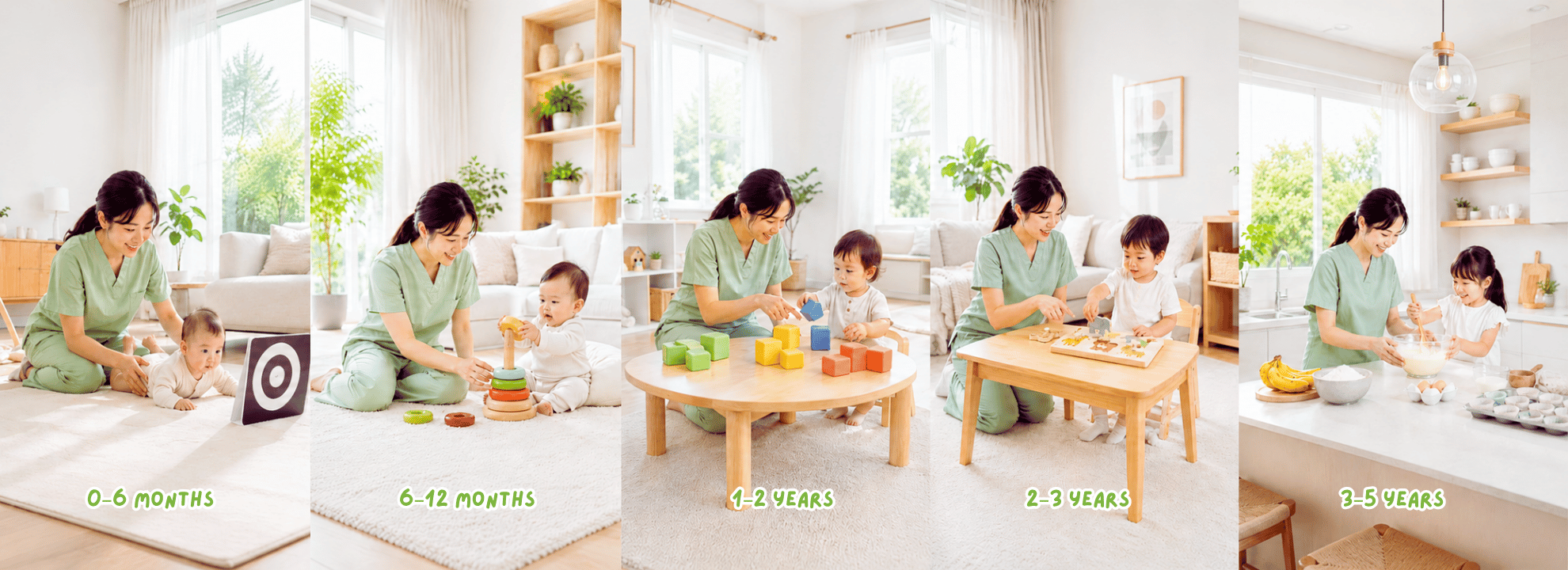
Age-Appropriate Nanny Activities from Birth to Age Five
The examples below are starting points, not a developmental test. Children develop at different rates, and activities should be adapted to the child’s abilities, temperament, health, and family guidance.
| Age | Suitable Daily Activities | Developmental Focus | Important Safety Note |
|---|---|---|---|
| 0–6 months | Face-to-face talking, singing, picture books, visual tracking, and supervised tummy time while awake. | Bonding, early communication, visual attention, and head and body control. | Stay directly beside the baby. Tummy time is for awake, supervised periods only. |
| 6–12 months | Peekaboo, naming objects, safe floor play, reaching games, and placing large objects into containers. | Attention, mobility, communication, and cause-and-effect learning. | Avoid small objects and unstable furniture; expect mouthing and increasing mobility. |
| 1–2 years | Blocks, action songs, simple pretend play, short stories, ball play, and outdoor movement. | Early language, imitation, coordination, and confidence. | Use large, age-appropriate materials and supervise climbing, food, and water closely. |
| 2–3 years | Sorting, simple puzzles, drawing, role play, two-step directions, and helping with small routines. | Problem-solving, language, fine motor skills, and independence. | Keep expectations short and flexible; stop if the child becomes overwhelmed or tired. |
| 3–5 years | Storytelling, crafts, turn-taking games, imaginative play, simple household tasks, and movement challenges. | Creativity, social skills, coordination, planning, and self-help abilities. | Choose non-toxic materials and set clear physical and social boundaries. |
Developmental milestones can help parents and caregivers notice how a child plays, learns, speaks, acts, and moves, but they are not a competition or a diagnosis. If a parent has concerns about development, the appropriate next step is to speak with the child’s healthcare professional.

Sample Nanny Daily Routine for a Toddler
This is an example, not a fixed programme. Meal, sleep, play, and activity times should follow the child’s age, usual routine, energy level, childcare setting, and family instructions.
| Time | Activity | Developmental Purpose |
|---|---|---|
| 08:00 | Breakfast and conversation | Language, connection, and self-help skills |
| 09:00 | Child-led play with a short guided activity | Curiosity, choice, and problem-solving |
| 10:00 | Outdoor or indoor movement | Gross motor development and body awareness |
| 11:30 | Lunch and hygiene routine | Independence and predictability |
| 12:30 | Nap or quiet time | Rest and emotional regulation |
| 14:30 | Sensory or creative play | Exploration and fine motor skills |
| 16:00 | Reading, music, or free play | Language, imagination, and connection |
How a Nanny Can Plan Activities Without Over-Scheduling the Day
- Start with the family’s established meal, nap, school, medical, and screen-use instructions.
- Observe the child’s energy, mood, interests, and signs of tiredness before choosing an activity.
- Plan a balanced mix: conversation and reading, movement, creative or sensory play, free play, routines, and rest.
- Prepare one or two simple alternatives rather than forcing the original plan.
- Repeat familiar activities. Children often learn through repetition, not constant novelty.
- Keep adult-led activities short enough for the child to remain comfortable and engaged.
Safety Guidelines for Nanny-Led Activities
- Use toys and materials that are suitable for the child’s age and abilities.
- Keep small objects away from children who may place items in their mouths.
- Supervise water activities continuously and remain within reach.
- Check allergies and family rules before using food, paint, plants, dough, or sensory materials.
- Practise tummy time only while the baby is awake and directly supervised.
- For infant sleep, follow current safe-sleep guidance: place the baby on their back on a firm, flat sleep surface and keep soft bedding and toys out of the sleep area.
- Follow the family’s medical, feeding, medication, sleep, transportation, photo-sharing, and emergency instructions.
- Stop or adapt an activity when the child appears tired, distressed, unwell, or overstimulated.
- Seek urgent help according to the family’s emergency plan when there is a medical or safety concern.
Common Activity-Planning Mistakes to Avoid
- Filling every minute with adult-led activities.
- Using screens as the automatic response to boredom instead of following the family’s plan.
- Choosing tasks that are too difficult, too long, or unsafe for the child.
- Continuing when the child is hungry, tired, distressed, or overwhelmed.
- Correcting the child so often that exploration becomes stressful.
- Comparing one child’s progress directly with another child’s progress.
- Prioritising finished artwork or a “perfect” result over curiosity and enjoyment.

How a Nanny Can Share Daily Progress with Parents
Brief, consistent updates help parents and the nanny adjust the routine together. The format can be a notebook, checklist, secure message, or family-approved app. The report should respect the family’s privacy and communication preferences.
Useful Information to Record
- Activities completed and what interested the child.
- Mood, energy, and any unusual changes in behaviour.
- New words, skills, questions, or attempts observed.
- Meals, fluids, naps, toileting, and medication only as instructed.
- Minor incidents, injuries, symptoms, safety concerns, and the action taken.
- A short suggestion for the next day, based on the child’s response.
A nanny can observe and report. They should not label a child, diagnose a delay, or promise that an activity will correct a developmental concern. Parents should discuss concerns with an appropriate healthcare professional.
Tips for Parents Working with a Nanny
- Share the child’s established routines, interests, allergies, health information, comfort strategies, and emergency contacts.
- Agree on a few realistic priorities instead of an inflexible daily curriculum.
- Provide safe materials and clarify which rooms, outdoor areas, devices, and activities may be used.
- Discuss discipline, screen use, food, transportation, photos, and social media before work begins.
- Review daily notes and hold regular, respectful check-ins.
- Allow the nanny appropriate breaks and enough transition time between care tasks.
Before interviewing a candidate, review these questions to ask before hiring a babysitter in Bangkok and discuss how the nanny would adapt activities to your child’s age, routine, and temperament.

Choosing a Nanny Who Can Support Your Family’s Routine
A suitable nanny does not need to entertain a child constantly or act as a therapist or teacher. More important qualities include attentive supervision, warm communication, age-relevant experience, sound judgement, respect for family instructions, and the ability to adapt calmly.
Kiidu has more than 10 years of experience supporting families in Thailand. The matching process can consider care requirements, schedule, language, location, and relevant experience. Candidate identity, documents, employment information, references, and background information are reviewed according to Kiidu’s screening process, and families can review profiles and interview candidates. Availability for on-demand, part-time, full-time, or live-in care depends on the location, schedule, and candidate availability.
Families can explore Kiidu nanny and babysitter services or ask the team to discuss the type of support that may suit their child’s age and household routine.
Conclusion
Daily nanny activities for child development work best when they are responsive, age-appropriate, safe, and woven naturally into the child’s routine. Reading, conversation, movement, creative play, problem-solving, self-care, free play, and rest can all contribute to a balanced day.
The goal is not to create a perfect timetable or accelerate development. It is to build a stable environment in which the child feels safe, noticed, and able to explore. Parents and nannies can achieve this by agreeing on expectations, observing the child’s cues, communicating consistently, and seeking professional advice when a developmental or health concern arises.
Frequently Asked Questions
💡What should a nanny do with a child every day?
A nanny should provide attentive supervision and a balanced mix of conversation, shared reading, movement, play, routines, free exploration, meals, transitions, and rest. The exact activities should match the child’s age, abilities, interests, and family instructions.
💡How many hours should a nanny play with a child?
There is no single number of play hours that is right for every child. Meaningful interaction can be spread across care routines, reading, movement, child-led play, and everyday conversation. The child also needs time for meals, transitions, independent play, quiet periods, and sleep.
💡Do nannies need a formal early-learning curriculum?
Usually not. For many young children, responsive interaction and age-appropriate play are more suitable than a rigid lesson plan. If a family uses a particular curriculum or a specialist has recommended activities, the nanny should follow the family’s instructions and work within their training and role.
💡What if a child refuses an activity?
The nanny can pause, offer a simpler choice, change the environment, or return to the activity later. Refusal may reflect tiredness, hunger, discomfort, difficulty, or a different interest. Forcing participation can make play stressful and is rarely necessary.
💡Can a nanny identify a developmental delay?
A nanny may notice and document changes or skills, but should not diagnose a developmental condition. Parents can compare observations over time and speak with a paediatrician or other qualified professional if they are concerned.
💡Should outdoor play happen every day?
Regular movement and opportunities to explore are useful, but outdoor plans should depend on the child’s health, age, weather, heat, air quality, location, and family rules. When outdoor play is not suitable, the nanny can offer safe indoor movement and active games.