
Hiring a Maid vs Cleaning Yourself in Bangkok: Which Saves More Long Term?

Cleaning your own home may appear to be the lowest cost option because there is no service fee. Yet the real cost includes time, cleaning supplies, equipment, physical effort, and the hours taken away from work, rest, or family. Hiring a maid involves a clear financial commitment, but it can create value by returning time and making household routines more consistent.
The better option is not the same for every household. A small condominium with light cleaning needs may be economical to maintain without outside help. A larger home, a demanding work schedule, frequent laundry, young children, older adults, or pets may change the calculation. The most useful comparison is therefore not price alone. It is the total long term value of each arrangement.
Key Takeaways
- Cleaning yourself usually has the lowest direct cash cost, but it still uses time, supplies, equipment, and physical energy.
- Hiring a maid may offer better value when regular cleaning competes with paid work, family care, recovery, or essential personal time.
- The scope of work matters. Cleaning, laundry, ironing, cooking, errands, and household organisation require different levels of time and skill.
- Part time, full time, and hybrid arrangements solve different household problems and should not be compared as if they were identical.
- Trust, privacy, working conditions, communication, and support during absences are part of the decision, even when they are difficult to express as a price.
- A fair decision uses real household data and confirmed service terms rather than a generic price list or unsupported estimate.
Hiring a Maid vs Cleaning Yourself: The Short Answer
| Short answer: Cleaning yourself may save more money when the home is small, the workload is light, and residents have enough time and ability to clean consistently. Hiring a maid may provide greater long term value when the household workload is substantial or when recovered time can be used for work, family, health, or rest. A hybrid arrangement can be the most practical middle option for many Bangkok households. |
This conclusion is deliberately conditional. Hiring help is not automatically cheaper, and cleaning yourself is not truly free. The decision becomes clearer when the household compares the same duties, frequency, quality expectations, and time period on both sides.

First Define What You Are Comparing
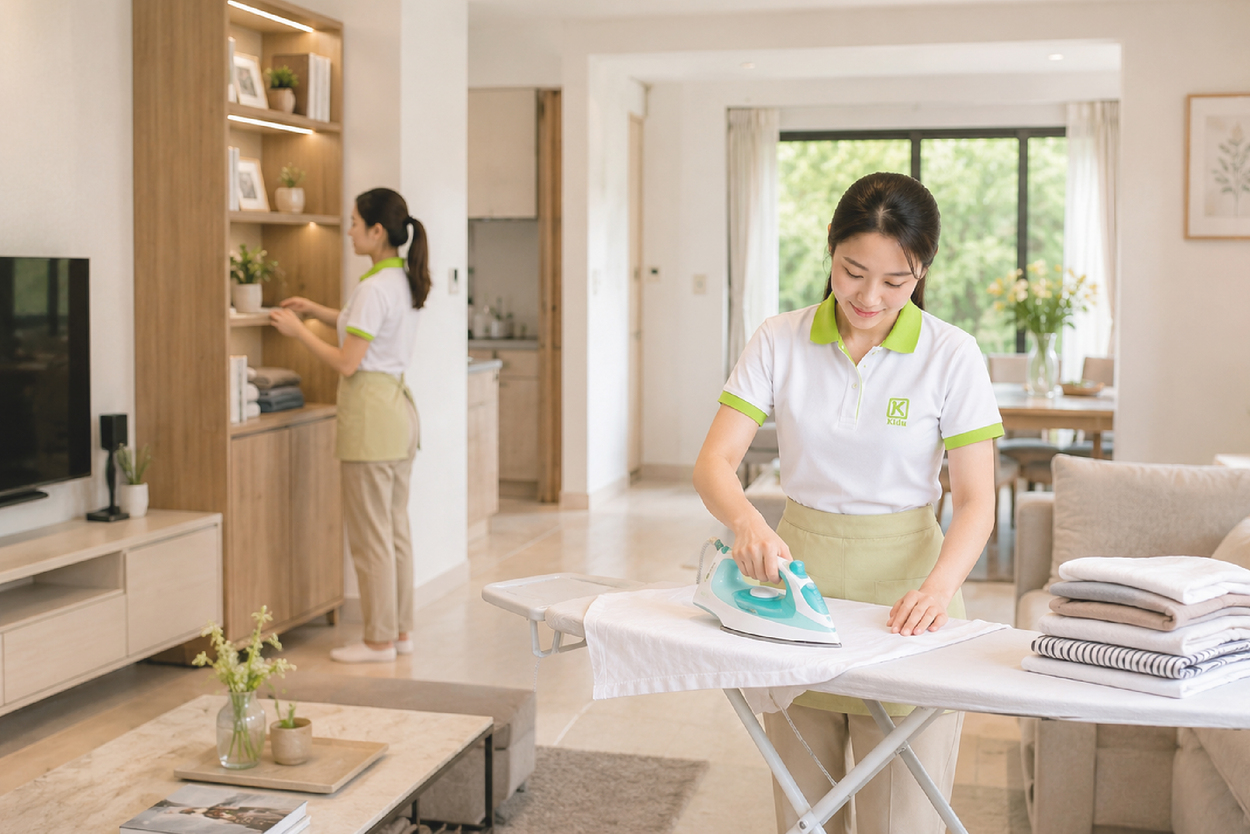
The words maid, cleaner, and housekeeper are often used interchangeably, but they may describe different responsibilities. A cleaning service may focus on floors, bathrooms, kitchens, dusting, and surfaces. A household maid may also handle laundry, ironing, organisation, basic cooking, or errands. Full time household help may support daily routines, while an occasional cleaner may complete a limited task list during a scheduled visit.
Before comparing cost, write down the work that the household actually needs. Comparing a basic cleaning visit with a role that includes laundry, cooking, pet related cleaning, and daily organisation produces a misleading result. The duties, hours, frequency, required experience, and expected standard must be comparable.
The True Cost of Cleaning Your Own Home
The direct cost of self cleaning is usually easy to see. It includes detergents, cloths, brushes, waste bags, gloves, mops, vacuum equipment, and replacement items. The less visible cost is the time spent performing, planning, and recovering from the work.

Calculate active cleaning time
Track how long the household spends on vacuuming, mopping, dusting, bathrooms, kitchens, laundry, ironing, changing bed linen, and general tidying. Use a normal month rather than an unusually quiet or demanding week. If several people share the work, record the time contributed by each person.
Include household management time
Cleaning also requires planning. Someone must notice that supplies are running low, select suitable products, buy or order them, prepare equipment, put everything away, and decide when deeper tasks should be completed. These minutes may feel insignificant in isolation, but they belong in the monthly calculation.
Assign a reasonable value to personal time
There is no single correct hourly value for personal time. One approach is to use net hourly earnings when cleaning replaces paid work. Another is to use the amount the person would reasonably pay to recover an hour for family, rest, exercise, or another priority. This value should be personal and realistic rather than inflated to force a preferred conclusion.
| DIY monthly cost: Cleaning hours per month multiplied by the value of personal time, plus supplies, equipment, replacement costs, and any occasional specialist cleaning. |
Households that want to examine time use more carefully can consult the Thailand National Statistical Office Time Use Survey. The survey is a useful reference point for understanding unpaid household activity, although every household should still calculate its own workload.
Consider physical effort and safety
Some tasks involve lifting, prolonged bending, reaching high areas, moving furniture, wet floors, or strong products. A person who finds these tasks difficult should not treat physical strain as an irrelevant cost. The safer response may be to simplify the routine, use suitable equipment, divide the work, or seek qualified help for demanding tasks.
The Total Cost of Hiring a Maid
The cost of hiring a maid in Bangkok depends on the arrangement and the scope of work. A one time cleaning visit, a recurring part time schedule, and a directly employed full time maid are different services with different responsibilities. Families should request terms based on their actual home and duties rather than assume that one advertised rate applies to every situation.
Service type and frequency
A smaller household may need occasional support for bathrooms, kitchens, windows, or deeper cleaning. A home with daily cooking, frequent laundry, children, pets, or several residents may need recurring support. Greater frequency usually increases direct cost, but it may also reduce accumulated work and make each visit more manageable.
Home size and workload
Bedrooms and floor area matter, but they do not describe the complete workload. Bathrooms, kitchens, balconies, stairs, delicate surfaces, storage areas, laundry volume, pet hair, cooking habits, and the number of residents can be equally important. Access requirements and travel may also affect the arrangement.
Skills and responsibilities
Routine cleaning requires a different profile from household support that includes cooking, ironing delicate clothing, caring for specialist materials, or communicating in a particular language. Families should separate essential duties from optional ones so that the candidate, working hours, and total cost can be evaluated fairly.
Recruitment and management time
Direct hiring may require advertising, screening, interviewing, checking documents and references, agreeing on working conditions, managing attendance, and planning for leave. A platform or service provider may assist with parts of this process, but the exact scope differs. Families should confirm what is included, what remains their responsibility, and whether replacement support is available under the selected terms.

| Hiring monthly cost: Confirmed wages or service fees, plus supplies, transport or access costs where applicable, employment related responsibilities, and the household time required for coordination. |
Side by Side Comparison
| Decision Factor | Cleaning Yourself | Hiring a Maid |
|---|---|---|
| Direct cash cost | Usually limited to supplies and equipment | Includes wages or service fees and any agreed related costs |
| Time required | All cleaning and planning time stays with the household | The household recovers task time but still coordinates priorities and access |
| Consistency | Depends on the residents’ schedule and energy | Depends on the worker, communication, checklist, and agreed frequency |
| Flexibility | Tasks can be completed whenever convenient | Work follows an agreed schedule and service conditions |
| Privacy | The household retains complete control of access | Requires clear access rules, restricted areas, and trust |
| Skills | Limited to the household’s knowledge, tools, and physical ability | Can be matched to specific duties when availability and experience are confirmed |
| Absences | Work waits or is shared by household members | Backup support depends on the provider and selected service terms |
| Best fit | Small homes, lighter needs, available time, and strong personal routines | Busy or larger households with recurring work and a clear budget |
Interpretation note: Compare confirmed arrangements. Service quality, tools, checklists, and replacement support vary by provider and contract.
When Cleaning Yourself Is Likely to Save More
Self cleaning is often the financially efficient choice when the home is compact, the workload is predictable, and residents can complete it without losing important work, rest, or family time. It also offers the greatest control over privacy, products, and timing.
- The home has few rooms and limited daily mess.
- Residents already own suitable equipment and know how to care for the home’s surfaces.
- Cleaning fits comfortably into the weekly routine.
- Privacy concerns outweigh the convenience of outside help.
- The household needs specialist help only occasionally.
The main limitation is sustainability. A routine that works during a quiet month may become difficult during busy work periods, illness, travel, family changes, or increased care responsibilities. Households should review the decision when circumstances change.

When Hiring a Maid May Offer Better Long Term Value
Hiring help becomes more attractive when cleaning takes time away from activities that the household values more highly. The benefit may be financial when recovered hours support paid work. It may also be practical or personal when the hours support childcare, older adult care, sleep, exercise, or family life.
- The home is large or contains several high use areas.
- Laundry, ironing, cooking, and organisation create recurring work beyond basic cleaning.
- Residents have long, irregular, or demanding work schedules.
- Children, pets, or several household members increase the daily workload.
- A resident has difficulty completing physically demanding tasks safely.
- The household values consistent routines and can manage the ongoing cost responsibly.
Professional support does not remove every household responsibility. Someone still needs to communicate priorities, provide safe working conditions, respect agreed boundaries, review results, and address changes in the workload.
Part Time, Full Time, or Hybrid Support
Occasional or part time support
This option may suit condominiums, small homes, or households that can manage daily tidying but need help with bathrooms, kitchens, floors, windows, or periodic deeper work. It limits ongoing cost while recovering time from the most demanding tasks.
Full time household help
Full time support may suit a home with substantial daily cleaning, laundry, cooking, or organisational needs. The value comes from continuity and broader availability, but the household must define duties, working hours, rest, leave, privacy, and management responsibilities clearly.
A hybrid routine
Many households do not need an all or nothing choice. Residents can handle dishes, light tidying, and immediate spills while scheduling professional help for floors, bathrooms, kitchens, laundry, or deeper tasks. A hybrid plan can balance cost, privacy, consistency, and time savings.
A Practical Decision Framework
- Track the household’s cleaning, laundry, ironing, shopping, and planning time for a normal month.
- List every required duty and separate essential work from optional support.
- Calculate the direct cost of self cleaning and assign a realistic value to the time involved.
- Request a confirmed quote or employment estimate based on the same duties, frequency, and location.
- Compare privacy, access, communication, safety, leave, and support conditions, not only price.
- Choose the smallest arrangement that solves the real problem, which may be occasional, part time, full time, or hybrid.
- Review the arrangement after the first month using time saved, work quality, reliability, communication, and total cost.
Trust, Privacy, and Working Conditions
Inviting someone into a private home requires more than comparing cleaning ability. Families should confirm identity and legal work status where applicable, review relevant experience and references, discuss access and restricted areas, protect personal information, and explain how keys, entry codes, valuables, cameras, and household routines will be handled.
Long term arrangements should also define duties, working hours, rest, leave, payment terms, supplies, cancellations, and what happens when either party cannot continue. Written expectations reduce ambiguity, but no screening process or agreement removes every risk. Ongoing communication and review remain important.
Domestic work should be treated as paid work with appropriate conditions. Families can review current information from the Thailand Ministry of Labour and the International Labour Organization. Rules and individual responsibilities can change, so confirm the requirements that apply to the selected arrangement and seek qualified advice when necessary.
For a practical hiring process, see Kiidu’s Maid Interview Questions and Trial Checklist. It covers role definition, consistent interview questions, document and reference checks, a paid practical trial, and performance review.

How Kiidu Supports Families
Kiidu helps families in Bangkok and selected areas of Thailand explore maid options based on household duties, schedule, language, location, and preferred working arrangement. Families can review available profiles, compare relevant experience and skills, and interview candidates before deciding.
The appropriate arrangement depends on household needs and current candidate availability. Confirm screening, training, fees, service coverage, and any replacement support before hiring.
Explore current options through the Kiidu Maid Service page or read the guide to Maid Services and Agencies.
| Next step: Not sure whether occasional, part time, or full time household help fits your needs? Speak with Kiidu to compare available profiles and service options based on your home, location, duties, and schedule. |
Conclusion
The long term winner between hiring a maid and cleaning yourself depends on what the household is trying to save. Self cleaning may preserve cash and privacy when the workload is light and time is available. Hiring a maid may return valuable hours and create a more consistent routine when the home or schedule demands regular support.
A good decision uses the same task list for both options, includes the value of time, and considers trust, working conditions, communication, and flexibility. For many Bangkok households, a hybrid routine offers a sensible starting point. The arrangement can then expand or reduce as the household’s needs change.
Frequently Asked Questions
Is hiring a maid cheaper than cleaning yourself?
Not always. Cleaning yourself usually has the lower direct cash cost, while hiring a maid adds wages or service fees. Hiring may offer better total value when the time recovered is more valuable than the additional cost. Household size, frequency, duties, and the value of personal time determine the result.
How should I calculate the cost of cleaning my own home?
Add the value of all cleaning and planning hours to the monthly cost of supplies, equipment, replacement items, and occasional specialist work. Use a realistic value for personal time and calculate over a normal month. Do not treat your own labour as automatically free.
How much time can hiring a maid save?
There is no reliable figure that applies to every home. Time savings depend on floor area, bathrooms, laundry, cooking, number of residents, pets, visit frequency, and assigned duties. Track your current workload first, then compare it with the tasks included in the proposed arrangement.
Should I choose part time or full time household help?
Part time support may be sufficient for smaller homes or selected weekly tasks. Full time help may suit households with substantial daily cleaning, laundry, cooking, or organisation. A hybrid arrangement can work when residents manage light daily tasks and use professional support for more demanding work.
What should I check before hiring a maid in Bangkok?
Define the role, confirm identity and legal work status where applicable, review experience and references, discuss duties and working conditions, agree on privacy and access rules, and confirm payment, leave, cancellations, and replacement terms. A paid practical trial can help assess real work when appropriate.
Can I combine self cleaning with a maid service?
Yes. A household can manage dishes, immediate spills, and daily tidying while scheduling help for bathrooms, floors, kitchens, laundry, windows, or deeper cleaning. This approach may reduce cost while preserving time for the tasks that residents find most difficult or demanding.